Dual-Mode User Sandboxing: Anonymous Session vs Authenticated State in Playground API
Deep dive into Dual-Mode User Sandboxing in Playground API: Anonymous Session-Level (user_id = 0) vs Authenticated User-Scoped (user_id > 0) hybrid state isolation.
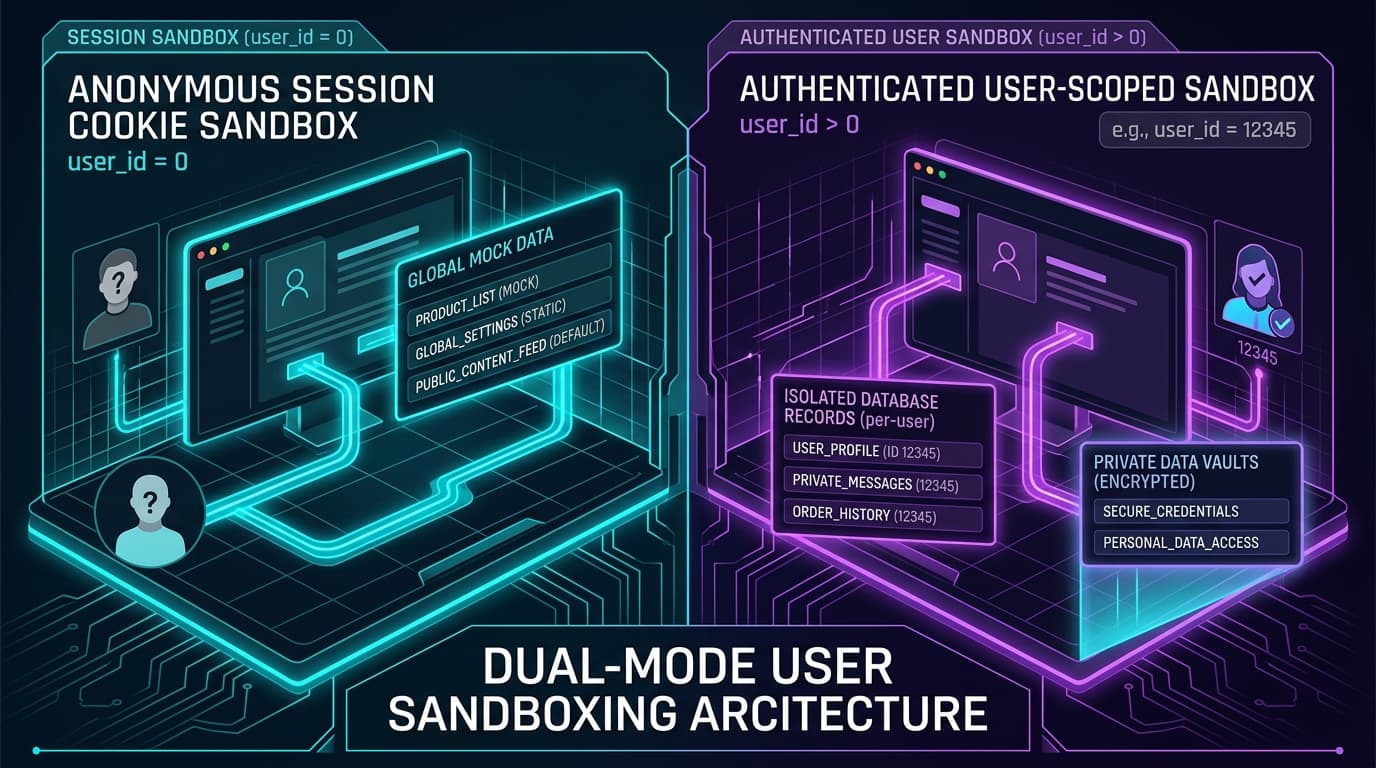
Dual-Mode User Sandboxing: Anonymous Session vs Authenticated State in Playground API
When developers prototype web applications, they frequently navigate two distinct phases:
- Anonymous / Guest Phase: Rapid UI prototyping without logging in, creating mock posts and comments that persist locally in the browser session.
- Authenticated / Multi-User Phase: Logging into distinct user accounts (
user_id = 1,user_id = 2) to test user profile ownership, private data isolation, and user-specific collections (/users/1/posts).
In traditional mock APIs, this hybrid model breaks: either all mutations are global (causing test pollution), or authentication is purely decorative.
Playground API solves this with an architectural breakthrough: Dual-Mode User Sandboxing!
1. Mode A: Anonymous Session Sandbox (user_id = 0)
When no Authorization: Bearer <jwt> header is provided:
- Playground API provisions a session sandbox tied to an HMAC-signed cookie or
X-Playground-Identityheader. - Mutations are overlaid on top of global seed data with virtual
user_id = 0. - Perfect for anonymous prototyping, public blogs, and landing page demos.
2. Mode B: Authenticated User-Scoped Sandbox (user_id > 0)
When a valid JWT is provided (Authorization: Bearer <token>):
- The overlay engine extracts the authenticated
user_id(e.g.user_id = 3). - All created records are strictly stamped with that user ID.
- Relational queries like
GET /users/3/postsorGET /todos?user_id=3automatically resolve both base seed data and that specific user's virtual mutations. - Other users in the same sandbox cannot modify or delete these records.
3. Seamless Transition & Migration
When an anonymous user registers or logs in during an interactive demo, Playground API seamlessly links the anonymous session mutations to the newly authenticated account, preserving UI continuity.
4. Interactive Sandboxing Studio
Inspect your active session tokens, identity hashes, and authenticated user state:
👉 https://playground.nileslabs.com/docs/sandboxing
Conclusion
Experience true full-stack realism without a dedicated database. Build with Playground API today!
Try Playground API in Your Own App
Stateful mock REST & GraphQL API with private sandbox overlays.