Stop Waiting for the Backend: A Frontend Developer's Guide to API Prototyping
Discover how frontend teams can work in parallel with backend engineers using API contracts, stateful mock sandboxes, and zero-downtime endpoint switching.
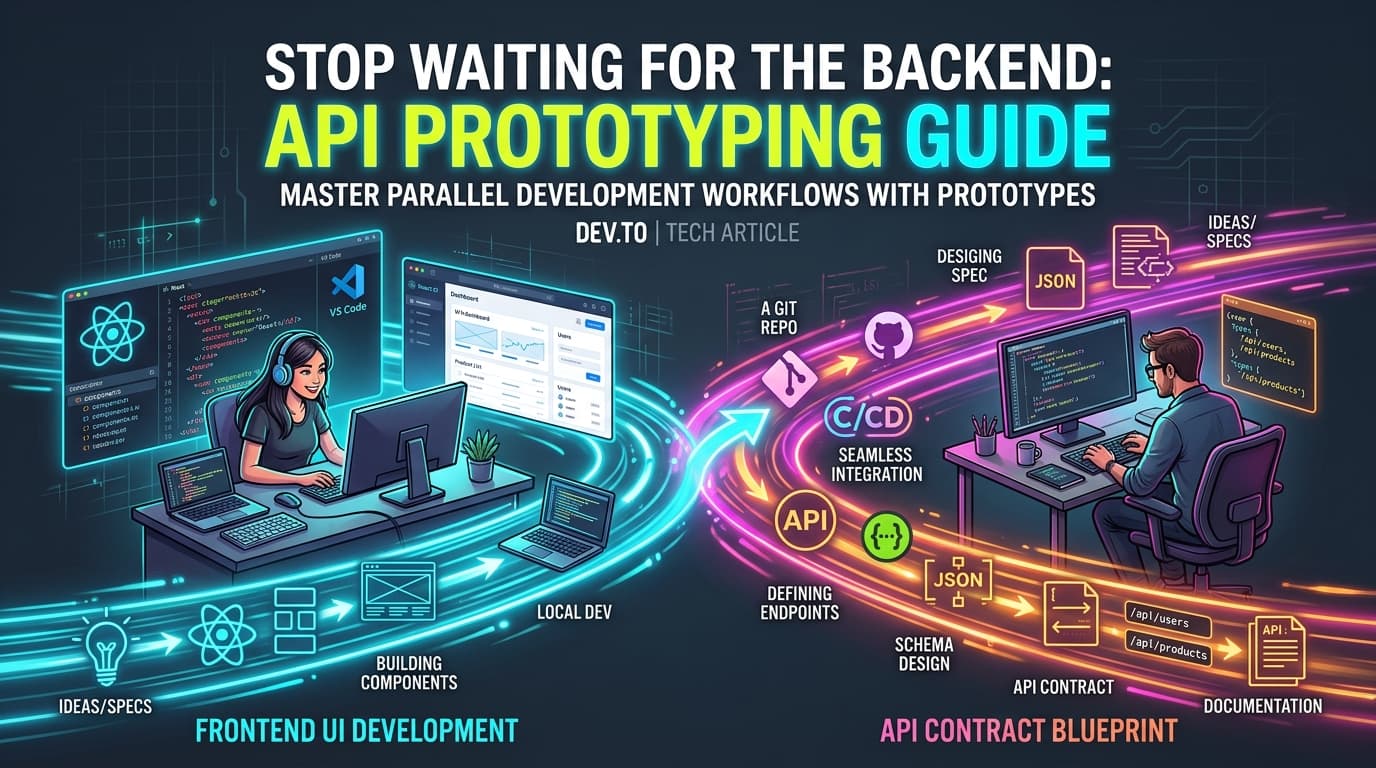
Stop Waiting for the Backend: A Frontend Developer's Guide to API Prototyping
Here is a common scenario in software teams:
Sprint planning begins on Monday. The product manager outlines an exciting new feature: a customer analytics dashboard with interactive filters, CRUD management, and real-time updates.
The backend team estimates their API work at 5 days.
The frontend team is told: "You can start building the UI once our database migrations and API endpoints are merged on Friday."
This creates an artificial bottleneck. Frontend engineers are forced to wait, rush their UI implementation over the weekend, or write throwaway mock adapters that must be rewritten when the real backend arrives.
It does not have to be this way. By adopting API Prototyping and Contract-First Development, frontend developers can build, test, and ship complete, interactive interfaces in parallel with the backend team.
The Waterfall Trap vs. Parallel Track Development
When teams develop sequentially, every delay in the backend blocks the frontend. When teams develop in parallel, both teams agree on a shared API Contract on day one:
By decoupling the frontend from the physical backend implementation, frontend engineers can:
- Validate user experience and design assumptions early.
- Build realistic error and loading states.
- Share interactive staging demos with product managers and stakeholders days ahead of schedule.
The 4 Steps to Successful Frontend API Prototyping
Step 1: Agree on the API Contract
Before writing code, both teams establish the endpoint paths, HTTP verbs, payload shapes, and status codes. For example:
GET /api/v1/posts?_page=1&_limit=10→ Returns paginated posts.POST /api/v1/posts→ Body:{ title: string, body: string, user_id: number }.DELETE /api/v1/posts/:id→ Returns200 OK.
Step 2: Connect to a Zero-Config Stateful Sandbox
Instead of building a temporary Node.js Express server on your machine that only you can access, use a hosted stateful sandbox like Playground API by Niles Labs.
Playground API provides pre-seeded datasets (users, posts, comments, todos) with full support for:
- CRUD mutations that persist per session
- Sorting (
?_sort=title&_order=asc) - Pagination (
?_page=1&_limit=10) - Latency injection (
?_delay=1000) - Error simulation (
?_status=500)
Step 3: Abstract Your API Layer with an Environment Variable
Always isolate your base API URL in an environment configuration file:
Step 4: The Zero-Friction Switch to Production
When Friday arrives and the backend team deploys their service, you don’t need to rewrite your React components or modify fetch hooks.
You simply update your .env.production file:
Because your frontend was developed and tested against real HTTP requests, headers, and status codes, the switch is seamless.
Concrete Example: Building an Interactive Admin Panel
Here is how straightforward it is to prototype an interactive user list with real-time deletion against a sandbox:
Summary
Waiting for backend APIs creates unnecessary friction and delays project delivery. By establishing early API contracts and developing against a stateful sandbox, frontend engineers gain the autonomy to build polished, fully-tested user interfaces from day one.
Unblock your frontend team today with Playground API by Niles Labs.
Try Playground API in Your Own App
Stateful mock REST & GraphQL API with private sandbox overlays.